

An ABS (Anti-lock Braking System) motorcycle is a system that prevents the vehicle's wheels from locking during braking, making it safer and more stable; whereas, a non-ABS motorcycle braking system is done conventionally. Learn which is better between ABS and non-ABS motorcycles for beginners and everyday riders.
Key Takeaways
- Because they stop the front wheel from locking during sudden or hard braking, ABS bikes offer greater safety.
- Bikes without ABS depend on the rider to operate the bike well, making their braking technique especially important.
- On beginner-friendly, daily riding, and especially in traffic and unpredictable road conditions, ABS is more appropriate.
- Non-ABS bikes are cheaper and easier to service, but are more challenging to ride and require more control and experience.
- In use on a daily basis, ABS offer greater control and confidence, especially on roads that are wet or slippery.
The difference between ABS vs non-ABS motorcycle is often a hot topic in automotive discussions along with the increasing public awareness of safety while riding. Many people are confused about choosing between a motorcycle with ABS (Anti-lock Braking System) or a non-ABS motorcycle because both are different in terms of price, performance, and control level during riding. However, since braking system is a crucial part of a motorcycle, it's important to understand the difference between ABS vs non-ABS motorcycle. This article will cover it thoroughly from the definition, how it works, the main differences between them, advantages and disadvantages, to which one is the most suitable for everyday use.
What is an ABS Motorcycle?
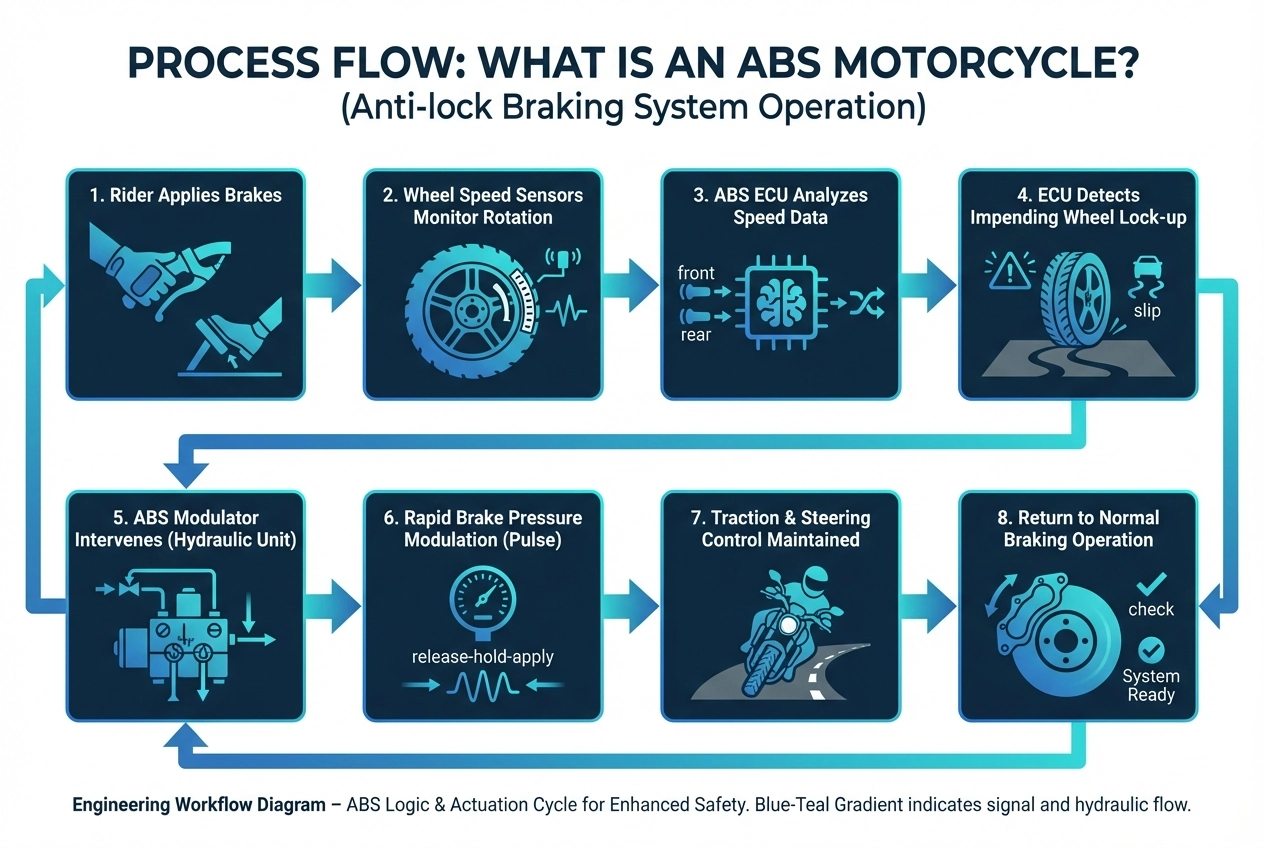
An ABS (Anti-lock Braking System) is a braking system found on motorcycles that's designed to prevent the wheels from locking up when the rider is braking suddenly or hard. With ABS, motorcycles become more stable and are able to avoid several accident risks. This is because ABS works by detecting the wheel rotation speed through a sensor, so the brake pressure is more organized and ensures that the wheel rotates while still gripping the road surface. The ABS on the motorcycle functions as a safety system, not to increase the motorcycle's speed or engine performance.
What is a Non-ABS Motorcycle?
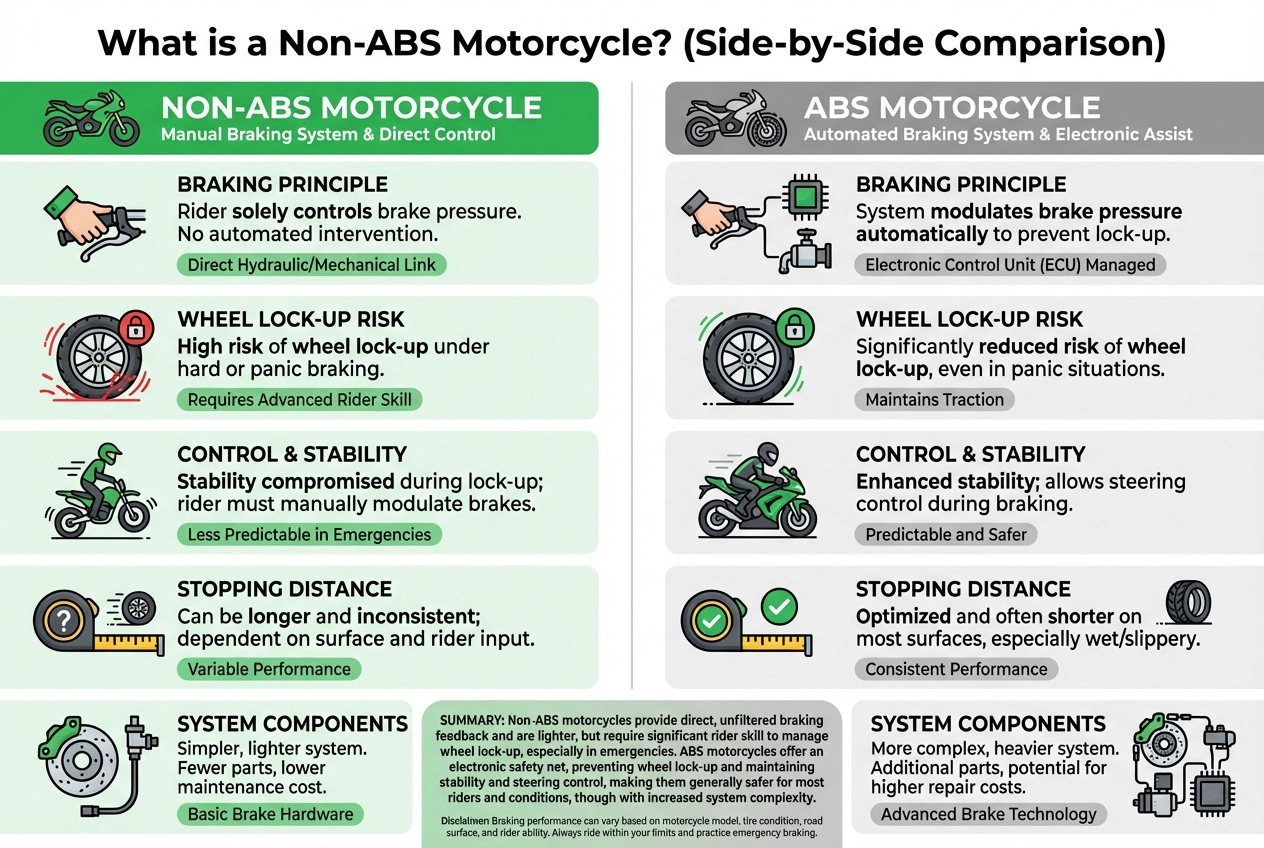
A non-ABS motorcycle is a motorcycle that doesn't come with an anti-lock braking system and only uses a conventional braking system. The braking system on this motorcycle will be controlled manually by the rider without any electronic assistance at all. Therefore, when riding on slippery roads or when braking suddenly, the wheels will lock and traction to the road surface vanishes. This puts the motorcycle in danger of skidding or becoming unstable and difficult to control.
How ABS Works Compared to Non-ABS Braking Systems
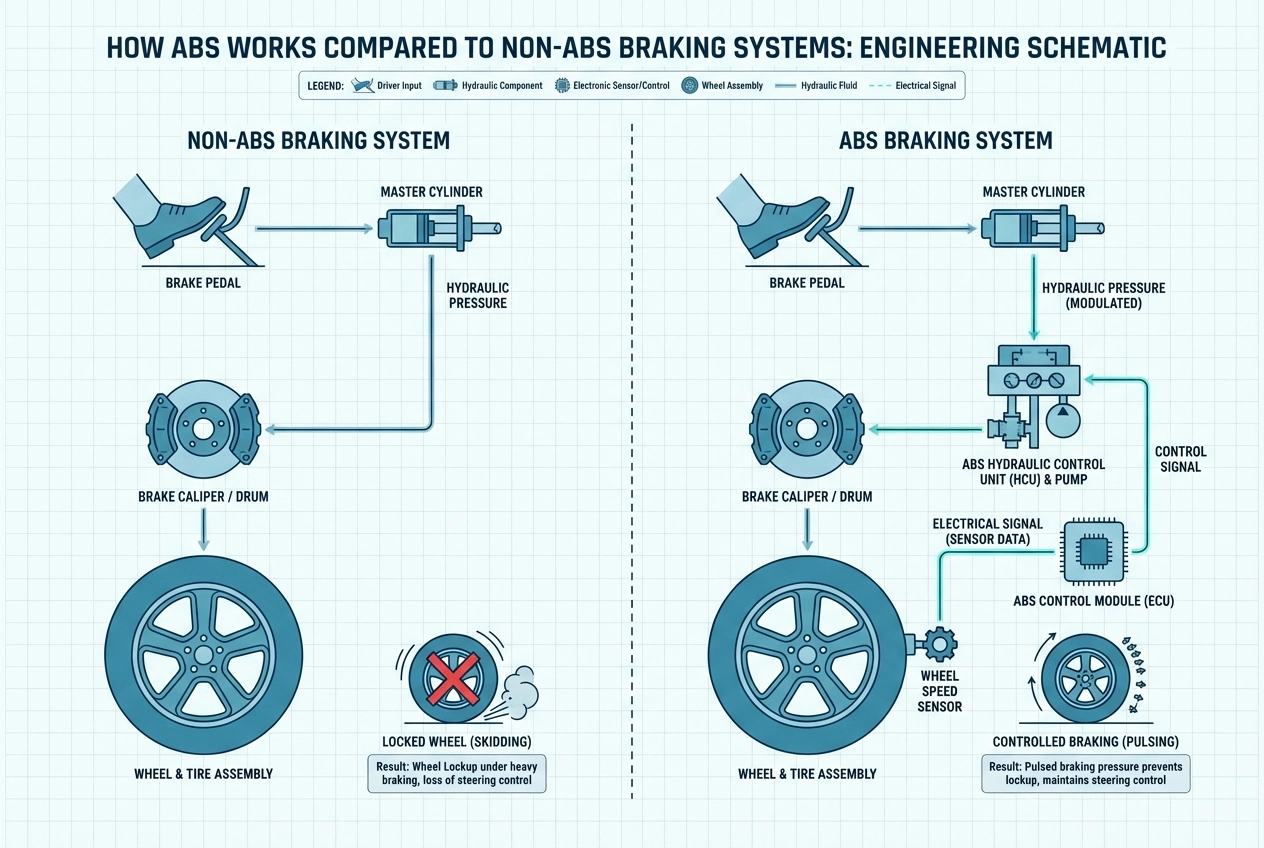
The main difference between ABS and non-ABS motorcycles is mainly in how they control the wheel during braking. For motorcycles with ABS, there's a system with sensors that measure wheel speed and monitor whether or not the wheels are about to lock up. When this sensor detects a rapid deceleration of the vehicle's wheel rotation, the ABS control unit rapidly modulates brake pressure within milliseconds to maintain traction and steering control. This systematic will happen repeatedly in quick time, allowing the wheels to keep spinning and have good traction with the road surface. While ABS doesn’t always shorten stopping distance on dry roads, it greatly improves control during panic braking. Whereas, on a non-ABS motorcycle, there's no system or sensor that can regulate the brake pressure at all. The braking input depends solely on the brake pressure applied by the rider. If the brake pressure is too strong and tight, the potential for wheel locking will occur. Thus, causing the rider to experience the risk of vehicle loss of control or skidding, especially when riding on slippery, wet, or sandy roads. With non-ABS motorcycles, riders need to understand how to perform gradual braking or engine braking techniques to maintain vehicle stability.
ABS vs Non-ABS Motorcycle: Key Comparisons Table
Although ABS and non-ABS motorcycles are different, it's important to know that both have the same purpose, which is to slow down and stop the motorcycle. However, the difference between both lies in their working methods and control levels during emergency situations. Aside from these things, below is a detailed discussion of the differences between both.
Advantages and Disadvantages of ABS Motorcycle
ABS motorcycle is known to not only offer various advantages in its use, but also disadvantages that need to be considered. Before finally deciding to choose this motorcycle, you need to understand some of the advantages and disadvantages as follows.
Advantages of ABS Motorcycle
Helps prevent the wheels from locking up during the emergency braking process–keeping the vehicle stable. Improves safety and security, especially when braking is sudden or reflex. ABS provides greater stability in real-world conditions such as rain, gravel, or sudden obstacle avoidance. With an automatic control system that ensures safety, riding with this motorcycle boosts the rider's confidence. ABS helps the steering remain stable during the braking process as it's not sudden, but gradual.
Disadvantages of ABS Motorcycle
Although ABS motorcycles are more expensive, the added safety often makes them worth the investment for most riders. ABS systems generally have more complex sensors and modules, so the maintenance process is more complex. When there's a fault in the ABS system, the repair cost will be quite high. The motorcycle becomes heavier with an ABS system although the difference isn't too significant.
Advantages and Disadvantages of Non-ABS Motorcycle
Because non-ABS systems are known to rely on conventional braking systems, they're not necessarily bad to use. Non-ABS motorcycles have advantages and disadvantages that need to be understood to determine the best choice for your daily riding needs. Therefore, below are some of the advantages and disadvantages of non-ABS motorcycles.
Advantages of Non-ABS Motorcycle
Has a much cheaper price compared to a motorcycle with ABS. The braking system is simpler because it's not integrated with sensors or electronic modules. Maintenance or repair costs will be much cheaper because it doesn't have a complex system. Without ABS, the motorcycle may be slightly lighter, though the difference is usually minimal. Ideal for experienced riders with good braking technique as it gives them full control over the braking process.
Disadvantages of Non-ABS Motorcycle
When sudden braking occurs, the potential for wheel lock-up increases significantly. The risk of skidding or unstable steering when riding on wet or slippery roads increases. The rider must adjust the brake pressure precisely to prevent potential accidents or falls from occurring. The safety level is quite low, as even small mistakes such as emergency braking will cause the driver to lose control. Not friendly for beginner riders as it requires a sensitive brake technique.
Which is Better: ABS or Non-ABS Motorcycle for Beginners and Daily Riding?
When asked which is better than ABS or non-ABS motorcycle for beginners, the answer is ABS motorcycle. The reason itself is very simple, where beginners lack good reflexes and also have insufficient experience to deal with various emergency situations on the road. ABS motorcycles are considered to be safer and more stable because they prevent the wheels from locking up when sudden braking occurs. As for daily use, ABS motorcycles are still recommended because they're safer to use for changing road conditions. Moreover, because the braking system is more controlled and smoother, it reduces the risk of accidents and helps riders with varied skills stay safe riding in various weather conditions. In conclusion, whether for beginners or for everyday use, ABS motorcycle is the right and suitable choice because it's safer and more stable, so the risk of accidents will be reduced. Meanwhile, non-ABS motorcycles are more ideal for experienced riders who have a good understanding of braking techniques.
Conclusion
Based on the previous discussion, it's known that ABS vs non-ABS motorcycles have the same function for the braking system, but with different ways and safety levels. ABS motorcycle is known to offer a high level of safety and security as it helps prevent the wheels from locking up during sudden braking, so the steering remains stable. Meanwhile, non-ABS motorcycles lack the automatic braking system control of ABS motorcycles. Thus, non-ABS motorcycles are ideal for experienced riders who are well-versed in braking techniques. Overall, for daily use and long-term safety, ABS motorcycle is still the best choice.
FAQs
Which is the best, one with ABS or without ABS?
ABS motorcycles are mostly better because they offer safety and stability during sudden braking. However, non-ABS also remain a good choice for experienced riders who prioritize simplicity and low cost.
What are the reasons for some people preferring non-ABS over ABS on their motorcycle?
Some of the main reasons include simpler system, fully manual braking control, economical price and maintenance cost, lighter motorcycle weight, and rider's personal preference.
How does an ABS system improve motorcycle braking in the rain compared to non-ABS motorcycles?
ABS helps maintain traction between wheels and the road, also prevents the wheels from locking up during slippery or wet road conditions. This is because the system will adjust the brake pressure automatically, keeping the motorcycle stable.
Is it difficult to ride a motorcycle without ABS?
It's not always difficult, but it does require a good braking technique. This is because the rider must be more aware of road conditions to prevent the wheels from locking up.
Is ABS crucial to have on a motorcycle?
Technically, ABS isn't really mandatory for all riding situations, but its use is highly recommended. This is because ABS improves riding safety, especially for beginners, daily use, or erratic road conditions.
Are there any tips for handling a non-ABS motorcycle as a beginner?
Yes, the main tips are to brake gradually–don't pull out suddenly, practice brake control, keep a safe distance from other vehicles, reduce speed when roads are slippery, and always focus on defensive riding techniques.
Does ABS increase stopping distance?
An ABS doesn't extend the braking distance, but rather helps to keep the braking distance optimal and maintain vehicle control and stability. However, on sandy or small gravel roads, the braking distance will be slightly longer than with manual braking techniques. But overall, with ABS, you don't have to worry about the wheels locking up and it helps the rider remain stable during emergency braking.
Is single-channel ABS sufficient?
Using single-channel ABS (generally installed on the front wheel) provides a significant safety improvement because most of the motorcycle's braking system comes from the front wheel. For daily mobility, single-channel is more than enough, while dual-channel is able to provide a more optimal safety level.