

Scooters vs motorcycles: which is better for city riding? Compare cost, performance, comfort, and practicality to choose the right vehicle for your needs.
Key Takeaways
- Scooters are generally better suited for daily urban commuting due to their automatic transmission, ease of use, and lower operating costs.
- Motorcycles are ideal for riders who prioritize performance, high-speed stability, and long-distance capability.
- Scooters are typically more affordable to purchase and maintain, while motorcycles tend to have higher upfront and maintenance costs due to larger engines and more complex systems.
- Scooters are more beginner-friendly, whereas motorcycles require greater skill and offer more rider control and engagement.
- The better choice depends on your riding purpose, distance, budget, and experience level rather than which vehicle is objectively "better."
Scooters and motorcycles are common vehicles used by urban residents for daily mobilization. Nowadays, people compare both vehicles to find out which one is the most suitable for their daily needs. Generally, scooters offer practicality and ease of riding, especially in urban areas, while motorcycles are more ideal for long-distance use as they provide good control and stability. However, choosing between scooters vs motorcycles shouldn't be done carelessly and must consider several factors, ranging from comfort, ease of use, and also safety level. To better understand the difference between scooters vs motorcycles, and which one is best suited for daily mobilization, this article will discuss the differences as a whole. Starting from the definition, key comparisons between both, ease of riding, safety features, pros and cons, to discuss which one is better and you should choose according to your needs.
What is a Scooter?
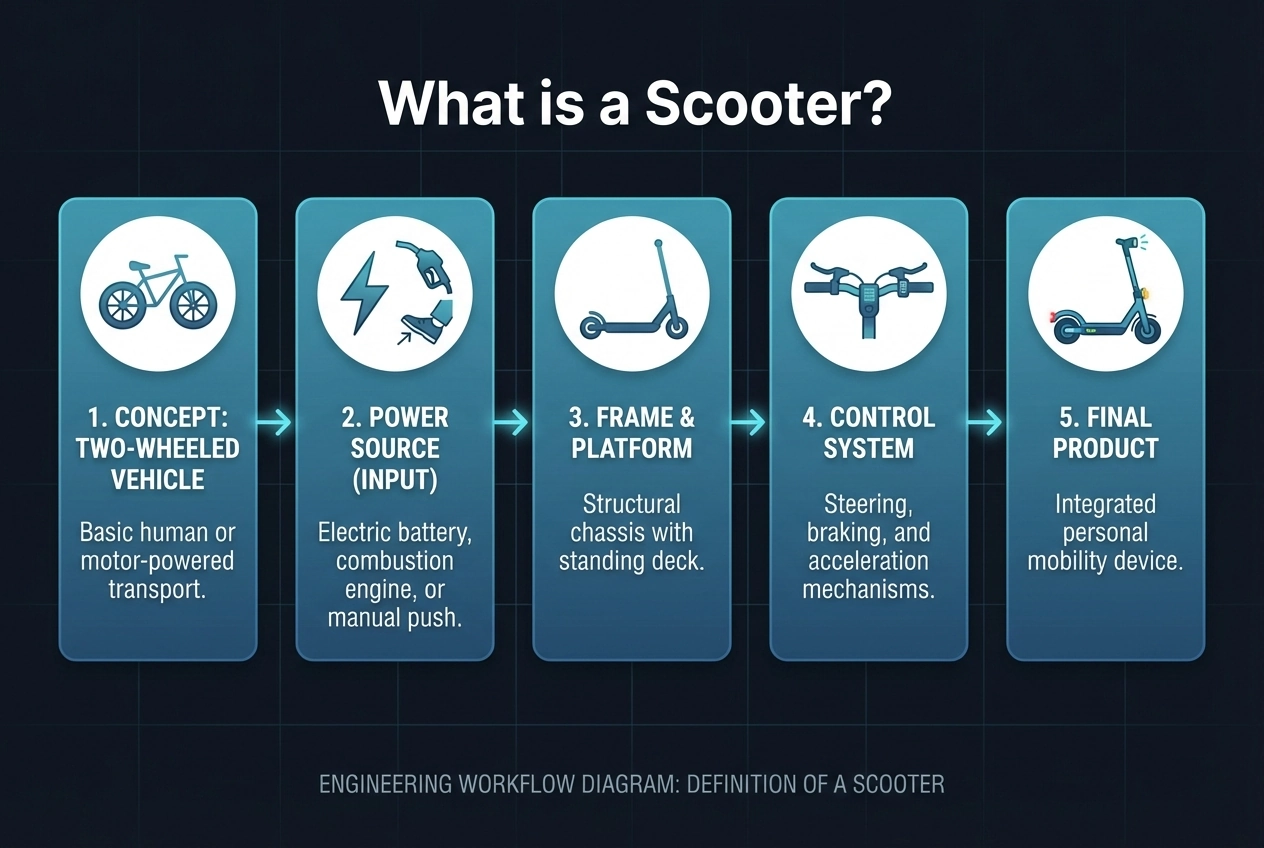
A scooter is a two-wheeled motorized vehicle that focuses on the convenience, practicality, and comfort of the user. Scooters use a CVT automatic transmission, allowing the user to not worry about shifting gears or using a clutch. Most scooters have a step through design, making it easy to get on and off the scooter, also there's an open area for a more relaxed riding position. The engine and automatic drive system are integrated with the rear wheel for a more lightweight design. The design makes scooters reliable for use by everyone from beginners to experts, and offers ease of use, comfort, and efficiency, rather than high performance.
What is a Motorcycle?
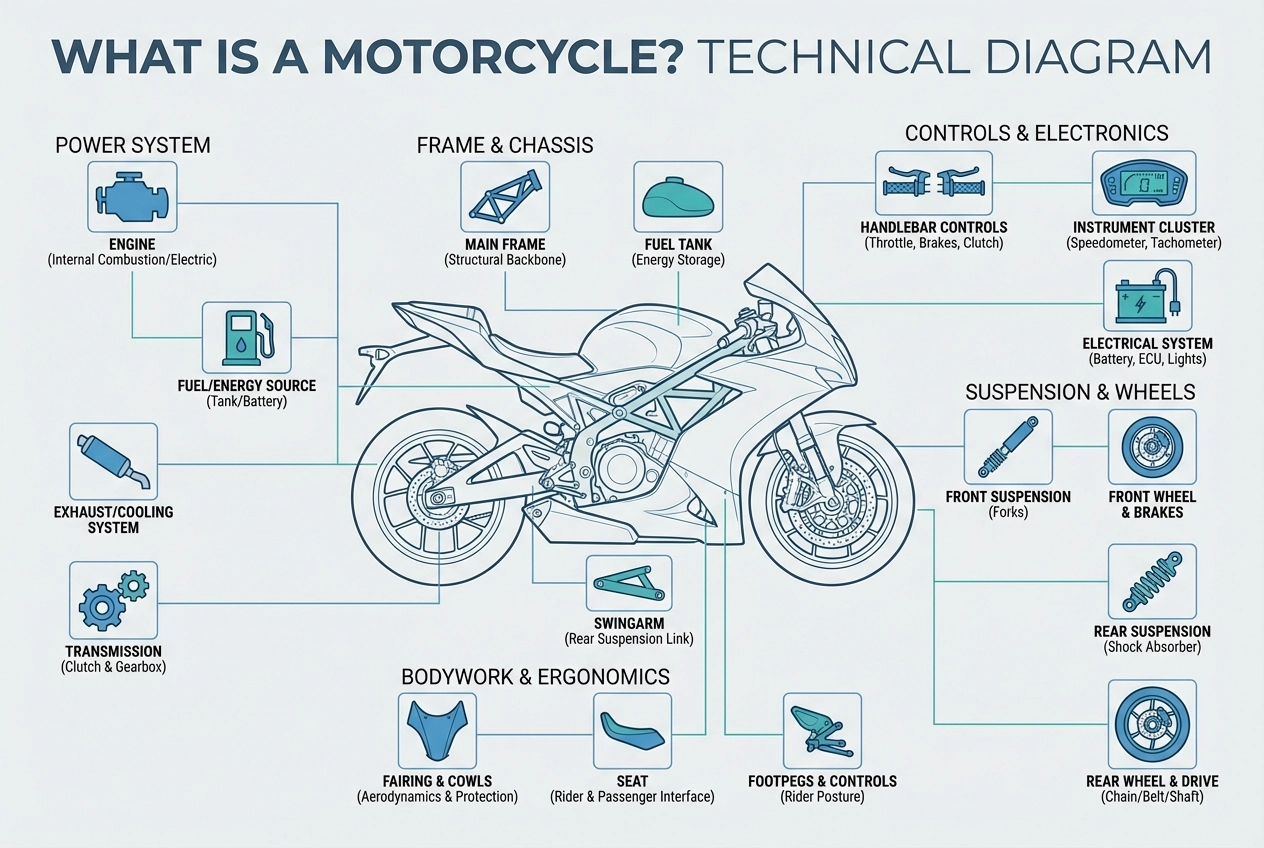
Motorcycles are defined as two-wheeled motorized vehicles that offer a significantly greater degree of control, performance, versatility, and driving enjoyment, as well as the ability to handle more challenging road conditions. Features of the motorcycles also include a more elaborate system of manual or semi-manual gears clutch mechanisms, which requires more skill and experience of the rider. The central positioning of the frame and engine for better balance and optimal distribution of stresses, and a more robust suspension. Motorcycles also have larger wheels and more powerful brakes which increases the stability of the motorcycle in cruising at high speeds and on a variety of road conditions. Due to the versatility offered in the driving experience and performance as well as the increased driving and performance challenges, the motorcycle requires more skill and experience of the driver than a scooter does.
Scooter vs Motorcycle: Key Comparisons Table
Although scooters and motorcycles are both two-wheeled vehicles, they're designed for different needs and priorities. Therefore, to understand the main differences between both, here's a scooter vs motorcycle comparison table that will help you make an objective decision when choosing between them.
| Comparison Aspects | Scooter | Motorcycle |
|---|---|---|
| Transmission | Automatic (CVT) and generally without a clutch | Manual or semi-manual transmission with a clutch |
| Speed | Low and much more stable at low-medium speed | Stable at high speed |
| Acceleration | Smooth and also consistent, so ideal for stop-and-go riding | Much more responsive and also powerful |
| Engine Capacity Range | Small to medium | Generally a wide range, from small to large |
| Frame Design | Step-through and flat foot deck | Closed frame and centered engine |
| Luggage Storage | There's space under the seat and also a sizable space in the frame's center | Most don't have any luggage storage |
| Riding Position | Upright and more relaxed, comfortable for daily riding | Varies from upright, leaning, and aggressive–depending on the motorcycle type |
| Daily Comfort | Ideal for short to medium trips | Ideal for long trips |
| Fuel Efficiency | Consumes less fuel | Much more wasteful due to larger engine capacity |
| Maintenance and Cost | Maintenance and service costs tend to be simpler and more affordable | Requires higher maintenance costs because the engine and system are more complex |
| Ownership Cost | Relatively more affordable because the engine capacity is low to medium and spare parts are cheaper | The ownership price is higher because the engine varies from medium to large and spare parts also tend to be more expensive |
| Use Suitability | Urban and daily mobility | Long distance to touring |
Scooter and Motorcycle: Ease of Riding and User Friendliness
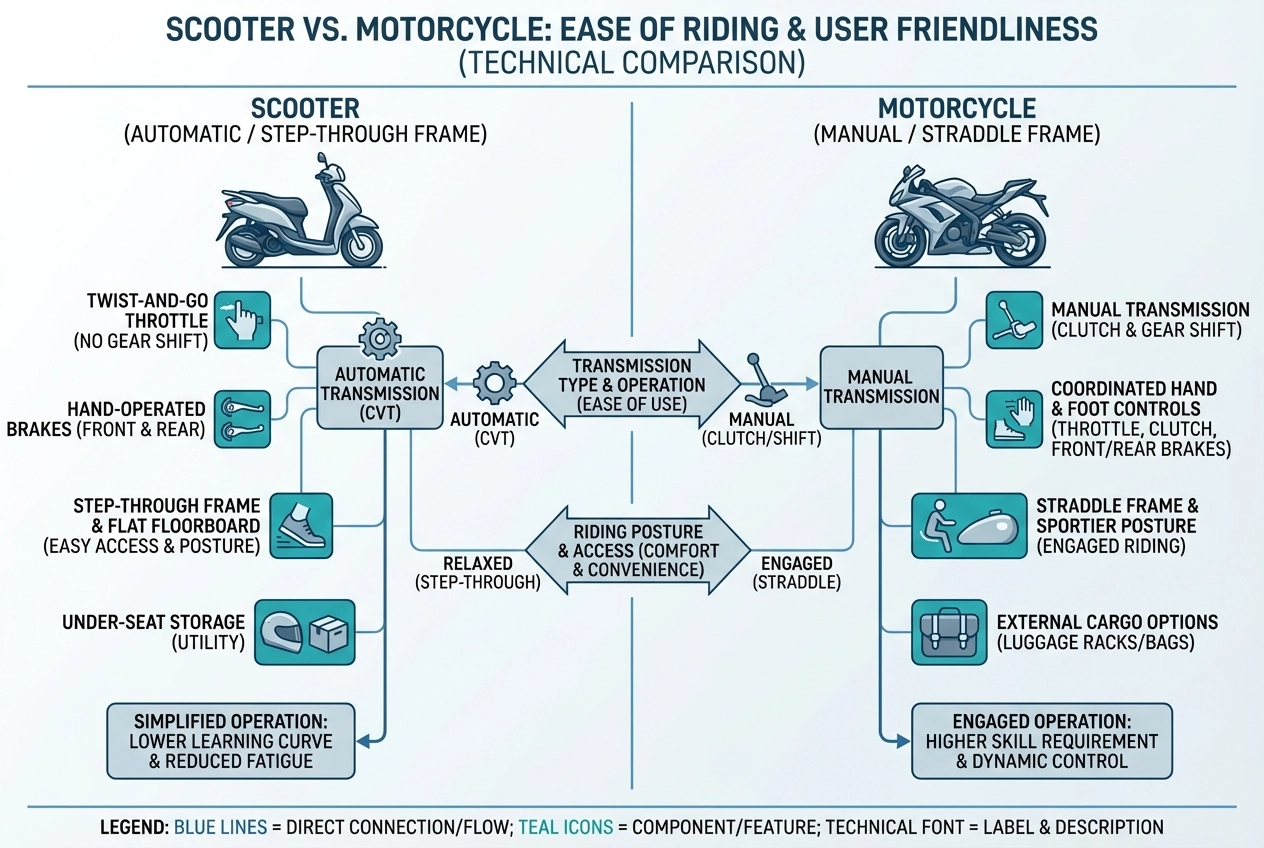
Scooters and motorcycles have different features that affect how easy they are to ride. Starting with scooters, they're made to be user-friendly for all types of riders–from newbies to pros. This is because they have automatic transmissions, so riders just need to sit comfortably and focus on the throttle and brake. Not to mention that their lighter construction makes them easier to maneuver when there's a lot of traffic or when they need to make a quick maneuver–like a u-turn. On the other side, motorcycles need active participation from the rider, as they have a fully manual or partially manual transmission. This means that a rider has to juggle the clutch, throttle, and gear shift all at once, and it has to be done at the same time and in the same order to avoid serious accidents. On highway roads where the motorcycle is driven at medium to high speeds, the vehicle will feel more stable and responsive. However, when the vehicle is used at low speeds or in traffic, the rider needs more skill to stay comfortable and safe. In conclusion, motorcycles are meant for riders with high skill, while scooters are fit for all types of riders. Overall scooters win in riding fun and ease, while motorbikes are just as fun and easy to control for pro riders.
Safety Features and Road Stability Between Scooter and Motorcycle
For safety features and road stability, scooters are generally equipped with CBS (Combined Braking System) or ABS (Anti-lock Braking System). These braking systems have the main function of preventing the wheels from locking up during sudden braking–especially when the road is slippery or wet. To understand more about these braking systems, read ABS vs non-ABS motorcycle. Additionally, the scooter's closed body design makes it more resistant to water splashes and dust. However, due to its small wheels and lightweight, the scooter's stability is more reliable at low to medium speeds for safety. Whereas, motorcycles are specifically designed to deal with various road conditions and be used at high speeds. The sturdier frame, larger wheels, stronger braking system, and longer suspension give the motorcycle better stability and control when cornering, speeding, or traveling through bumpy roads. The safety features found on motorcycles are much more modern, consisting of multi-channel ABS, traction control, and engine brake control.
Scooter vs Motorcycle: Pros and Cons
Before finally deciding to choose a scooter or motorcycle objectively, understanding the advantages and disadvantages of each is very important. Although each offers its own advantages, there are disadvantages that need to be understood and considered. Below is a more complete discussion of the pros and cons of scooters and motorcycles.
Pros and Cons of Scooters
Pros: Automatic transmission is easier to use while riding Daily commuting is easier to use with daily traffic More fuel efficient Rider is able to have a more relaxed and comfortable riding position There's under seat storage Cons: Speed and performance are limited which is a downside High speed may become a problem Rough roads become a problem due to smaller wheel size Driving involves less engagement due to less feeling of overall control More performance issues
Pros and Cons of Motorcycle
Pros: More performance and more speed are available High speed control is much better Good on long distances and can handle more diverse road conditions Control steering is more precise and better overall There is a wide variety of engine capacities Cons: More dangerous for beginner riders Not suitable for riding in busy traffic More fuel is used Operational costs are higher Driving requires more skill and greater attentiveness
Which is Better: Scooter or Motorcycle?
When choosing between a scooter and a motorcycle, there's generally no absolute answer as to which one is better–generally, everything needs to be tailored to the user's needs.
Choose a Scooter If
You mainly want a vehicle that convenience and practical. You want a vehicle with an ergonomic design with a relaxed riding position. You want a vehicle with low fuel consumption. You want a vehicle with good storage for cargo. You want a vehicle for short and daily commutes.
Choose a Motorcycle If
You want a vehicle for specific uses, and you need a vehicle for the most control, performance, and flexibility. You want a vehicle with a fully manual (or partly) transmission for better control at the driver's discretion for higher speeds, better construction, and better performance plus control systems for high control response and high speed. You need a vehicle for significant long-distance travel You need a vehicle for various surfaces and significant distance. In the end, the comparison between the two is about more than just the usage, comfort and performance, and factors include the overall purpose and intended use situation.
Conclusion
The comparison of scooter vs motorcycle shows that both are designed for different needs. Scooters have lightweight designs that are more suited towards comfy short journeys through cities. In contrast, motorcycles provide more performance-centric features, including greater levels of stability and control that are better suited for riding over greater distances and in more variable environments. However, motorcycles tend to generally be more expensive, both in terms of the initial cost and the ongoing expenses associated with fuel, insurance, maintenance, and repairs. In choosing which to purchase, the rider's preferences, use, and the environment should support the final decision. With the right decision, you'll be able to choose the most appropriate and efficient type of two-wheeler for long-term use.
FAQs
Should I buy a scooter or motorcycle?
Generally, the best option between the two depends on what the user needs the most. If you want something that is practical, cost-effective, and useful when it comes to everyday transportation, then a scooter is the best option. A motorcycle is better when you want something that is performance-based, provides better control, and has versatility on different types of terrain.
What are the differences between riding a motorcycle and a scooter?
The biggest difference is the transmission system and the control and feel of the ride. Scooters have automatics and motorcycle have manual and semi-manual systems.
Which is better for daily commute: a scooter or a motorcycle?
When it comes to urban settings and heavy congestion, scooters are the better option for everyday use. Motorcycles are better suited for long-range travels.
Is riding a motorcycle more fun than riding a scooter?
Motorcycles are better fun for the experienced user who prioritize performance, acceleration, and active control. The definition of "fun" is different for everyone and scooters are seen by some people to be enjoyable to use.
Is a scooter safer than a motorcycle?
Overall safety depends on the road, the user, and the safety gear so the type of vehicle has little relevance to that.
Which is better for long-term use considering its range, durability, and maintenance cost?
Motorcycles are superior when it comes to flexible and reliable use, but have a higher maintenance cost. Meanwhile, Scooters are superior in terms of lower maintenance costs and better fuel efficiency.


